The Art of Un-Teaching: Why Your Yoga Practice Doesn’t Need More Answers
Discover how Socrates’ “Midwife Method” aligns with therapeutic yoga and self-inquiry to help you stop controlling your practice and start trusting your body’s innate wisdom.
We often step onto our yoga mats or sit on our meditation cushions with a subtle, unspoken intention: to fix something.
We arrive seeking techniques, alignment rules, and answers. We look to our practice to quiet our minds, align our bodies, or cultivate a peace that feels just out of reach.
But what if wisdom isn’t something to be acquired, collected, or poured into us like water into an empty vessel? What if the most transformative moments in practice happen not when we learn something new, but when we dismantle what was never true in the first place?
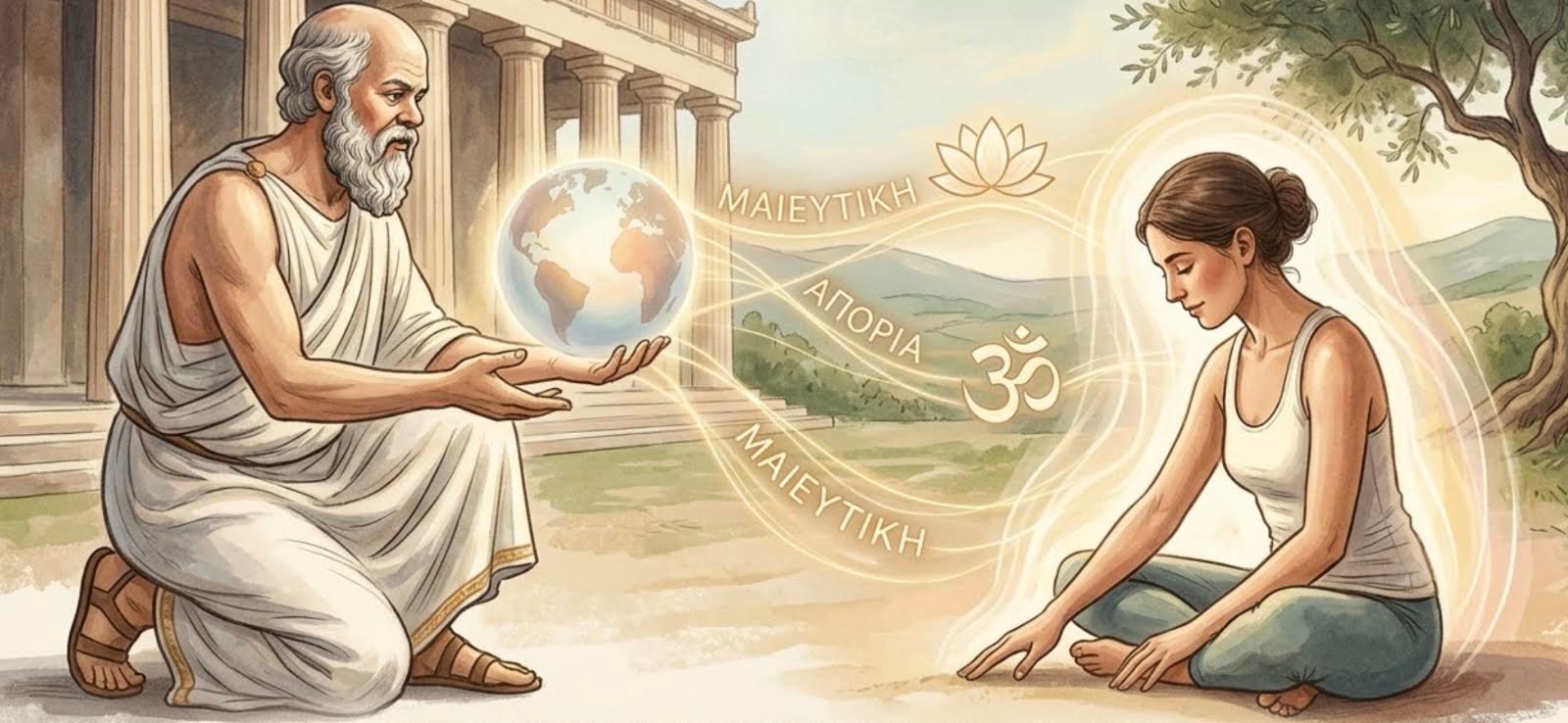
Centuries before modern somatic practices took root, the philosopher Socrates described his role as a teacher in a surprising way. He didn’t call himself a master or an authority. Instead, he called himself a midwife of the soul (Maieutics).
Socrates noted that a physical midwife does not give birth to the child—she simply creates a safe, supportive environment and assists the mother in delivering what is already carrying life within her.
The Teacher as a Mirror, Not a Master
In therapeutic yoga and self-inquiry, this aligns seamlessly with the principle of Swadhyaya (self-study) and Jnana (direct experiential wisdom). True yoga does not demand dogma or performance. It offers a clear, gentle mirror.
When a yoga guide operates like a midwife rather than an instructor, the entire dynamic shifts:
- From Instruction to Inquiry: Instead of being told, “Relax your shoulders so you don’t hold stress,” you are invited to explore: “Where in your body are you holding effort that isn’t required right now?”
- From Fixing to Observing: Instead of trying to force a quiet mind, you are asked: “Who is the one observing these thoughts as they come and go?”
This subtle shift moves us out of the habit of “managing” our bodies and directly into present-moment feeling.
Entering Aporia: The Space Where Effort Ends
When Socrates asked questions that stripped away false assumptions, his students often arrived at a state called Aporia—a fertile state of puzzled awe or productive stillness. It is the moment when the rigid, calculating mind runs out of answers and simply pauses.
In classical yoga, this corresponds to the moment the mental chatter (Vritti) breaks down, making space for stillness (Nirodha).
When you rest in a posture and finally stop trying to achieve an ideal form, a quiet realization emerges: you don’t have to orchestrate your own peace. The floor is already catching your weight. The breath is already breathing you.
When effort ends, Grace begins.
3 Socratic Inquiries for Your Next Practice
The next time you step onto your mat or rest in stillness, replace self-judgment with three open-ended Socratic questions:
- On Effort: “Am I inhabiting this pose, or am I trying to control it?”
- On Expectation: “Who decided how far this shape is supposed to go today?”
- On Presence: “If there is nothing to fix, achieve, or prove in this exact breath—what remains?”
Leave a generous gap of silence after each question. Don’t rush to answer with words or logic. Allow your breath and physical sensation to deliver the insight in their own time.

You may also like

Vrittis: Choosing Your Inner Blueprint: Returning to Your True Self

Silence Is Real Power